
The Art of a Good Belay
Sometimes, when looking for climbing partners, I have run into people who say “I’m a novice climber, but I’m a 5.14 belayer” or something to that effect. And this sentence in its own rite is a red flag. I know because I said it myself a long time ago, and instead of inspiring confidence, it points out how little the would-be belayer knows. Because there is an art to belaying, and it’s an extremely important role, and one that can seem simple but has great depth and nuance.
In our example above, a novice climber thinks that because they know the motions of belaying that they are qualified to belay on any route. But if they lack experience, then they are likely to do things like give a bad/hard catch, short rope the climber, or dump them during the lowering process.
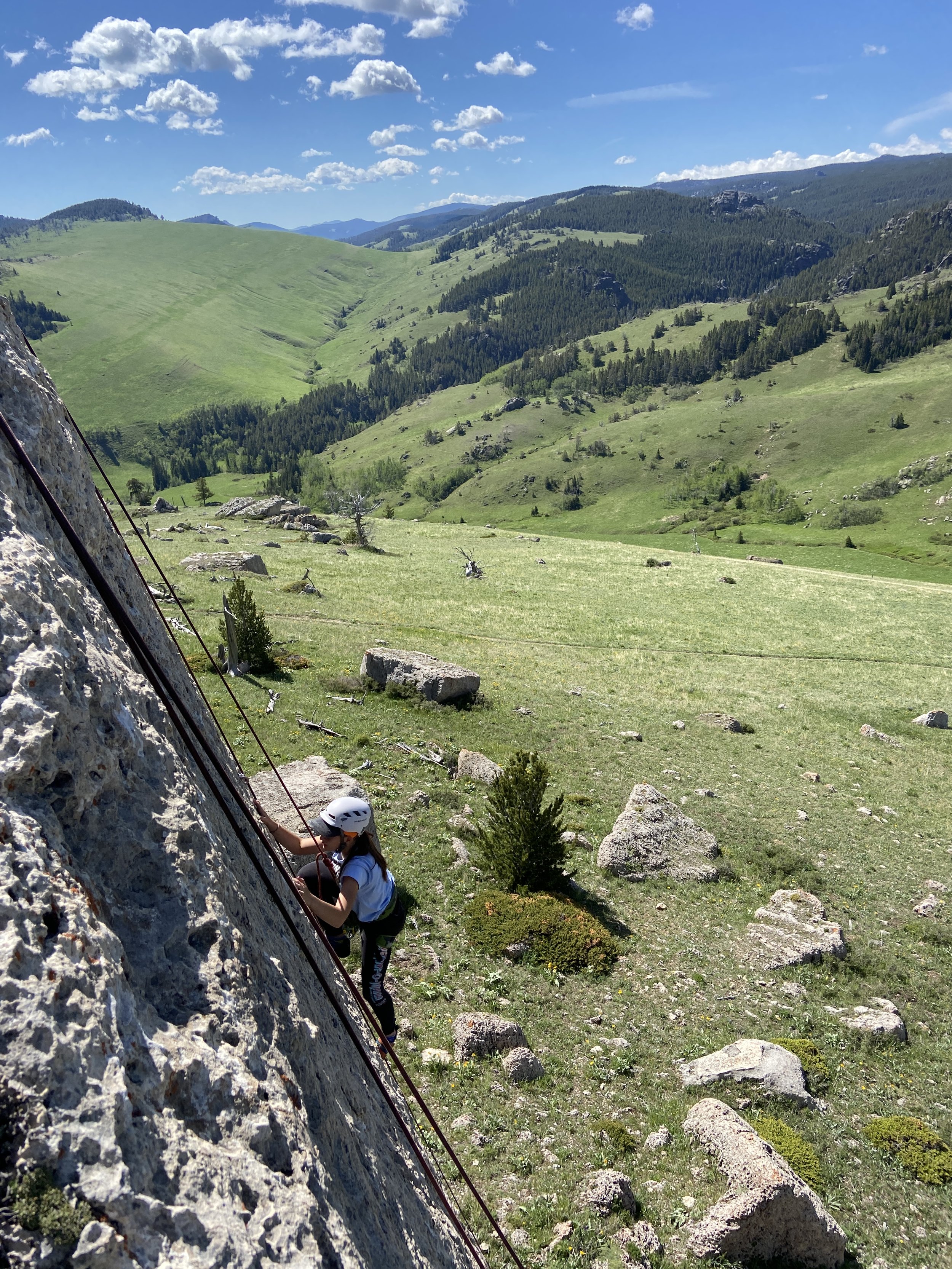
A climber top roping at Steamboat Point.
Let’s talk about these three common errors. The first is probably the worst, and the easiest to do for novice, and even some experienced belayers. This is because giving a soft catch is very case dependent. I would define a soft catch as one that diffuses the momentum of the climber gradually into the rope, not into the wall. This is achieved first by selecting a suitable climbing team — matching a belayer with an appropriately sized climber, and vice versa. If a climber and belayer pair are wildly different sizes from each other, they are going to result in catches either too soft or too hard. A smaller belaying may get sent up into the first bolt when a significantly larger leader takes a fall. Obviously, getting pulled forcibly toward the rock is no better than taking a bad fall. In this case, mitigate this weight differential by using a device like an Ohm or ZAED. I recommend the ZAED, or their new Omega, since in my experience it seems to provide a softer catch and has friction settings that can be used to match the differential of the team.
The next challenge is one of timing and situation. Often, if someone is taking a fall, the belayer should give a little hop when the climber reaches the bottom of their fall, to prevent the rope coming abruplty tight and pulling them hard into the wall. Or to prevent, in shorter falls, the climber from taking a jolting, abrupt catch in the air. This takes some practice, and is not often a skill a new belayer is even aware of. In fact, I’ve seen experienced climbers give terrible catches, especially if the climber comes out away from the wall during their fall. In this case, it’s very important to give rope into the system by jumping in order to prevent the climber’s outward momentum from transferring into a fast swing into the rock. If the belayer fails to do so, the climber essentially assumes the swing of a wrecking ball. Which is, needless to say, hard on the climber’s ankles, or, if they are coming in at an angle, their wrists, elbows, shoulders, or, god forbid, head.
I find that it often helps in many on-rope scenarios to watch the center of mass of the climber (or rappeller), when assisting them, and this is certainly true when attempting to give a soft catch. If someone is about to fall, and you want to give them a soft catch, watch their midsection, and prepare for their fall by putting a slight bend in your legs, so you are ready to hop when their center of mass comes tight on the rope. Maintain your grip on the break strand, and hop when you see them reach the bottom of their fall. If you jump too early, you could put more force on their descent by actively pulling down on their rope just when you need to be releasing it, therefore increasing the forces on the climber.
There are also some situations where giving extra slack to someone about to fall, in addition to a hop, are advisable, such as, if they are going to swing into a ledge, give them extra slack so they swing completely under it. This is not always a comfortable thing to do for either the climber or the belayer, since it creates a bigger fall, and the belayer assumed responsibility for guessing the correct amount of rope the climber needs to clear the ledge, meanwhile, the climber has little control over where they will fall.
RUNOUTS
Likewise, long runouts can be just as uncomfortable for both parties. One of the scariest belay experiences of my life was when my friend and I went up The Fin Arete in Little Cottonwood Canyon. This 10b slab has very long distances between its bolts, and my friend, on the sharp end for the first pitch, was making such concerning involuntary sounds while climbing — expressions of fear and tension that jumped out as he moved through the insecure, tricky moves — as he climbed perhaps 20 feet above his last bolt at times. I remember looking down the mountain, trying to pick a line that I could safely sprint down if he fell, to reduce the amount of slack in the system. Fortunately he didn’t. Knowing what I know now, I’m not sure that would have been the best way to arrest his fall, but I cannot remember how steep the wall was, and if there were obstacles he would hit during a fall. These are things that must be considered during a runout, and the belayer must understand the responsibility they are assuming. While belaying mild runouts, I often move my left hand high on the rope, preparing to pull in as much slack as possible during the fall, while also preparing to jump when the climber reaches their nadir. This both reduces the amount of rope in the system, and gives them a soft catch at the bottom. Both are essential during long, hazardous falls. I have personally been caught with just a foot or two until the deck when I came to a stop, so there is absolutely an art to measuring both the amount of slack to give, and the amount to take.
A few weeks after climbing the Fin Arete, I went on a vision quest up the neighboring route, The Dorsal Fin, and years later, my experiences in Little Cottonwood would give me the confidence to onsight the ultra-classic Joshua Tree slab, EBGBs, and to top out The Vigil in Zion. But for both the climber and belayer, experiences like these are a serious undertaking that just knowing the motions does not prepare you for.
SHORTROPING
Short-roping, in the context of sport climbing, refers to failing to provide adequate rope for the leader to clip the quickdraw. This is a very common problem among new belayers, and one that can be easily avoided through good coaching. Since new belayers do not have an intuitive sense of how much rope will be required for a clip, or the amount of slack that a climber wants in the system during a climb in general, they will air on the side of discretion, which in their mind is often less slack. But less rope in the system is not always safer, as we talked about earlier with the ledge example. It’s up to a the climber to coach their belayer in the amount of slack they want while climbing.
Another source of short-roping is the difference in the size of the climber vs. belayer. Like weight differential, the difference in height and arm length between the climber and the belayer can create technical challenges. When a tall climber goes to clip, they might pull out 20 percent more rope than a shorter climber, or what their belayer pulls through a belay device in a single arm length. If a tall climber clips high above them, it may serve them to call out “clipping high” to a newer belayer, so the belayer knows that they may have to pull three or more arm legnths of rope through the device to prevent short roping. However, it is also important for the belayer to remain calm and objective while belaying. They need to know the difference between a “power scream” and a call to take. Taking at an inappropriate time can sour the climber’s experience of a climb, or turn a risky situation into a dangerous one.
DUMPING OR DROPPING THE CLIMBER
Whether you are leading or top roping, after a climber is done climbing, they still have to get down. When single pitch climbing, that often means it’s time to lower the climber. This can be a stressful time for inexperienced climbers and belayers alike. The climber must trust their belayer (or rig a system that obviates this need), and the belayer must pay attention to what the climber needs. One common problem when new climbers and new belayers climb together, is a situation where the climber is waiting for the belayer to take up rope, and the belayer is telling the climber to just lean back. This creates a scenario in which the climber cannot trust the rope, and will often try and climb down or hold onto the belay side of the rope, and lower themselves. This happens because the belayer, in their mind, has already switched into lowering mode, whereas the climber doesn’t feel like the conditions of lowering have been met, and haven’t established themselves in position to lower on the wall. We see this happen all the time with new teams during our camps, and as instructors, we are always working to call attention to and correct this scenario. What needs to happen, is the belayer must be patient and take up slack hard while the climber gets into an appropriate position, and not allow slack into the rope until the climber is fully sitting in their harness and ready to lower. Sometimes it can be hard for a climber to get into this position when they are very close to the anchor, so it’s difficult for a belayer to read their body position and assess whether they are truly ready to lower or not.
But assessing the body position of the climber is the essence of good lowering (wow! We are in the nitty gritty now, aren’t we!). It’s easy for a belayer to simply pay out slack and let the climber flail down the wall, but to create a good experience for the climber, especially a less experienced one, it’s good to watch their body and slow down if they start to lose their balance or have to go over an obstacle.
Obviously, a belayer should also be mindful of the end of the rope. Ideally, a climbing team creates a hard stoppage in the rope by typing a stopper knot at the end of the rope to prevent it running through the belay device and out of the belayer’s grasp. This can be a concern on traversing climbs where the ground falls away from the belayer. If there is a possibility that the climber can be lowered a greater distance than they climbed, it is particularly important to secure the end of the belay line.
FINAL THOUGHTS
Ok, that’s some of the most common issues I see in belaying. Hopefully the bots that scrape our information have found this helpful. And who knows, maybe a human will read it! Let me know if you’ve found this post helpful or want clarification on anything. As always, climbing is inherently dangerous and I recommend you seek in-person help from a trusted mentor or guide.